Back
EverUp Review

EverUp
10M coins Cashback Signup Bonus
The gift card cashback app I use for supermarket shopping. Buy giftcards, scan the barcode at the till like a Clubcard, get paid cashback instantly.
See full offer details →
Opinion / Review
EverUp Instant Cashback App Review
The gift card cashback app I use for supermarket shopping. Buy giftcards, scan the barcode at the till like a Clubcard, get paid cashback instantly.
Cashback Signup Bonus · 10M coins
T&Cs apply. See full offer details →
Last updated 1 September 2026
On This Page
- What is EverUp?
- Why I rate EverUp first
- Why trust this review?
- How I use it
- How EverUp cashback works
- What it does well
- Where it falls short
- Is EverUp safe?
- What I’ve earned
- How EverUp compares on live rates right now
- How to sign up for EverUp
- Payouts
- EverUp Quick Facts
- Should you use EverUp?
- Frequently Asked Questions
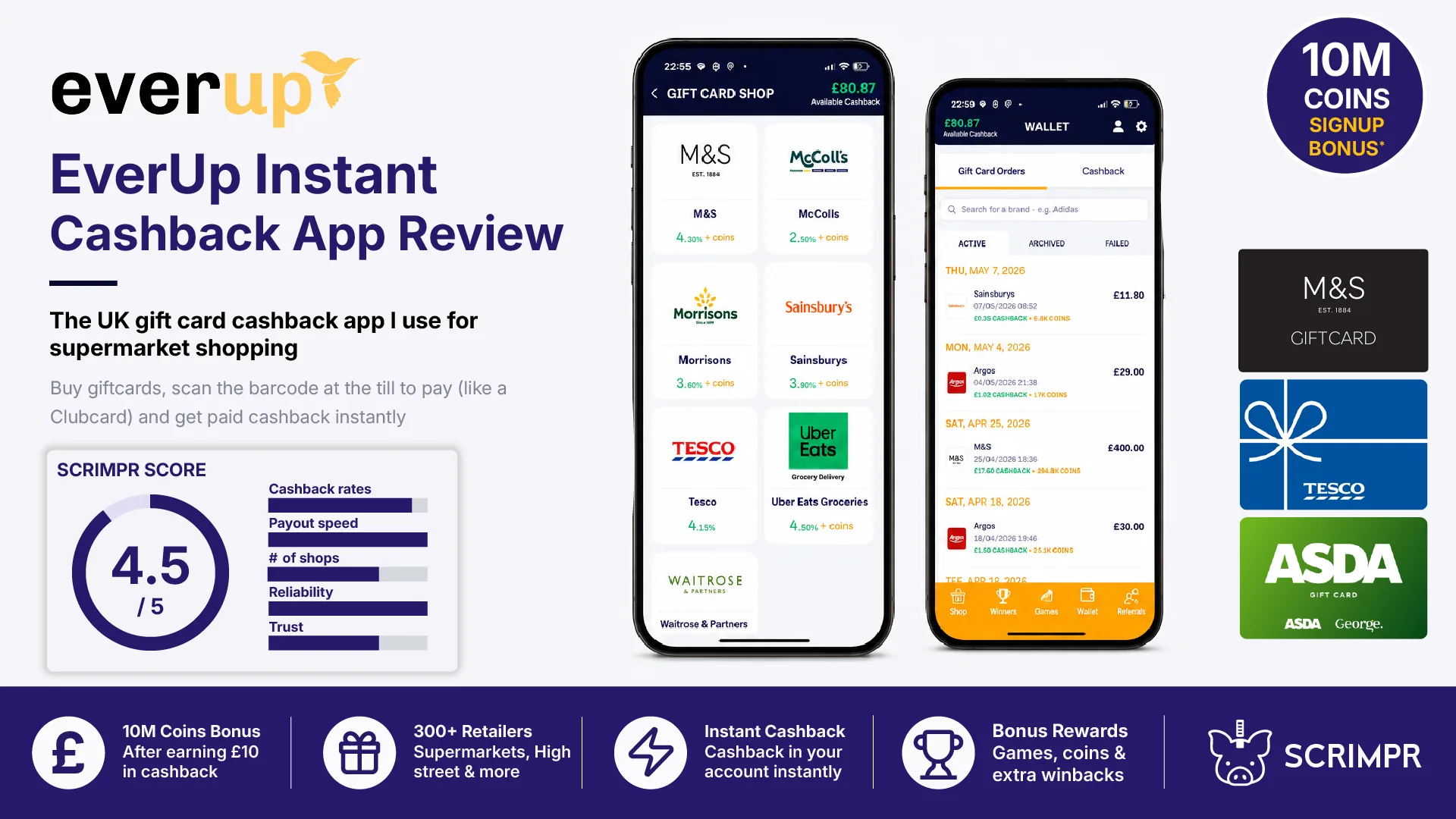
What is EverUp?
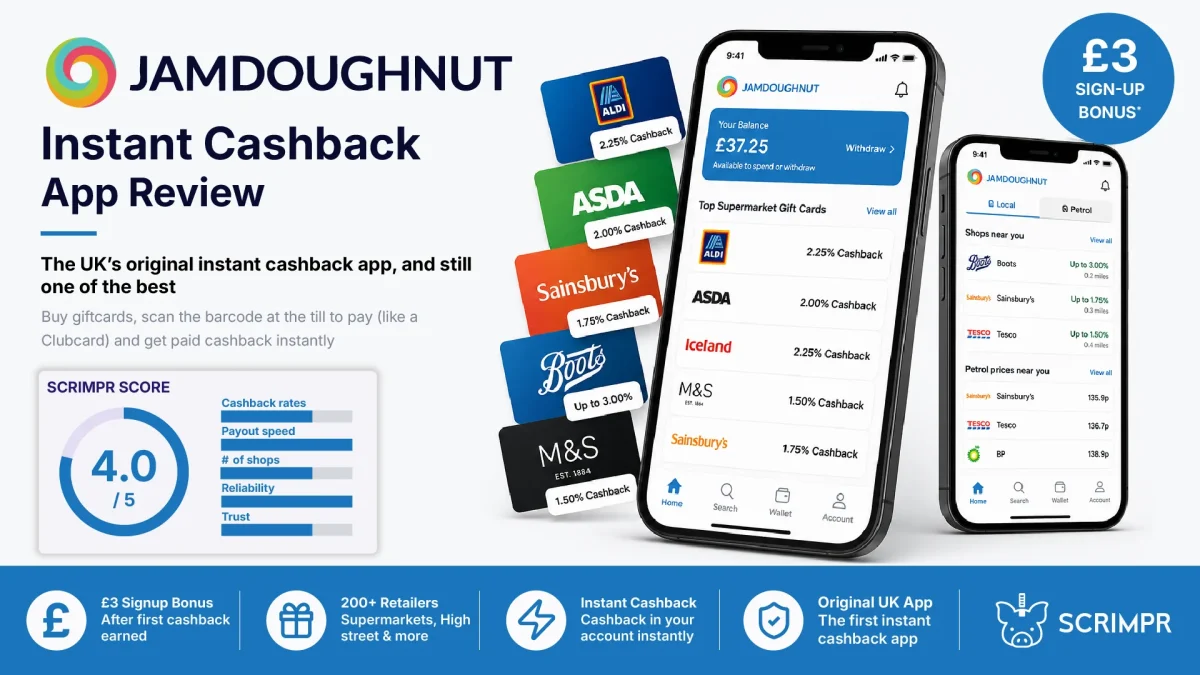
EverUp* is a gift card cashback app. You buy digital gift cards through the app for major retailers (Tesco, Sainsbury’s, Morrisons, M&S, Argos, Amazon, Boots and around 300 more) and cashback is added to your EverUp balance the moment you buy. At the till, you scan the gift card barcode straight from your phone like a loyalty card, and it stacks alongside your Clubcard, Nectar or equivalent. The cashback is yours to spend on more gift cards immediately, or withdraw to your bank from £10. The whole loop is instant: no pending period, no tracking that can fail.
If you remember EverUp from when they first launched, you might remember them as a prize-linked savings app. They shifted focus to gift card cashback in 2023.
It’s a 30-second habit, not a lifestyle change
Yes, you have to change how you pay at the till. But the swap takes about 30 seconds: open the app at checkout, buy a gift card for the amount you’re about to spend, then scan its barcode like a Clubcard. Once you’ve done it once you’ll keep doing it, because every shop saves you a few percent on money you were spending anyway.
Important things to know
Read these before you sign up so cashback actually saves you money instead of costing you money.
Should you use EverUp?
Yes, especially if your weekly food shop is £50+. EverUp usually pays the highest supermarket gift card rates and the cashback is instant. For online shopping, utility switches and financial products, you’ll still want a cashback site like TopCashback alongside it.
Why I rate EverUp first
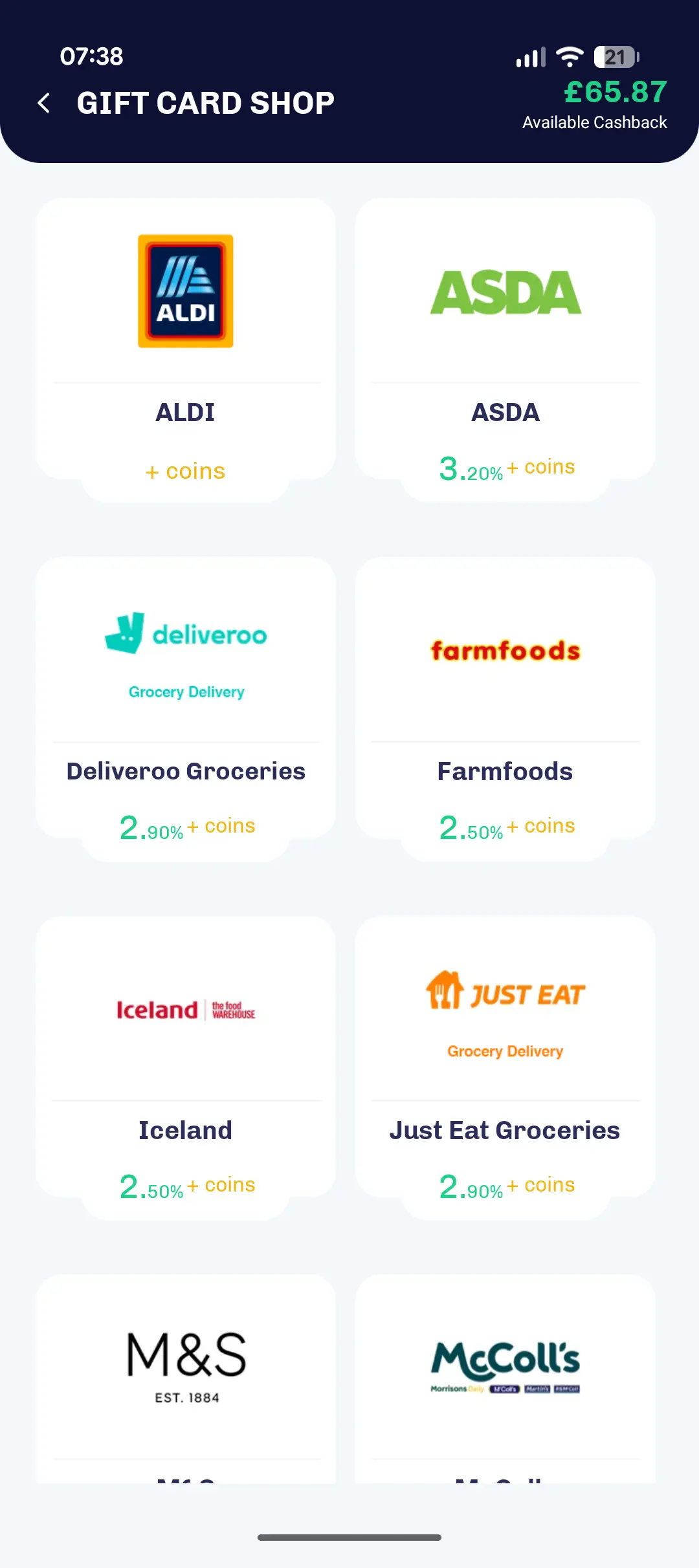
EverUp is the gift card cashback app I use and recommend for supermarket spend. It pays cashback instantly, has a very large range of retailers, and its supermarket rates tend to beat JamDoughnut‘s, although the two are usually close. Close enough that I check both before any sizeable purchase. But unless JamDoughnut is running a promotion, EverUp usually wins.
Paying with an EverUp gift card is simple. You buy the digital gift card on your phone, the cashback is added to your balance immediately, and at the till you scan the gift card barcode from the EverUp app, just like a Clubcard. Your normal loyalty points still build on your Clubcard or Nectar card. And if you’ve used a cashback debit card to buy the gift card, that pays you on top.
The cashback is instant. The moment you buy the gift card, the cashback is in your balance, spendable straight away on more gift cards from £1, or withdrawable to your bank from £10. No waiting, nothing pending.
It’s free money on shopping you’d already be doing.
Why trust this review?
I moderate r/BeermoneyUK (150,000+ subscribers) and wrote the cashback guides that sit in the community wiki. That content eventually grew into Scrimpr, including the cashback comparison tool I built and now run. Building it means I have active accounts at every cashback site worth comparing, including TopCashback, Quidco (with paid Premium), EverUp and JamDoughnut. For supermarket gift card cashback specifically, EverUp pays more often than any of the others.
One disclosure: clicking through to EverUp* from this page pays Scrimpr a referral if you sign up, and signing up via my link gets you 10 million bonus coins (worth around £1.50) after you’ve earned your first £10 of cashback. The recommendation isn’t conditional on the affiliate. EverUp would still be the gift card cashback app I’d suggest first if the link paid nothing.
How I use it
The pattern is straightforward: before any sizeable supermarket shop, open EverUp, buy a digital gift card for the amount you need, and scan the barcode at the till alongside your loyalty card. Cashback is added to your balance immediately. Loyalty points still build normally on your Clubcard, Nectar or equivalent.
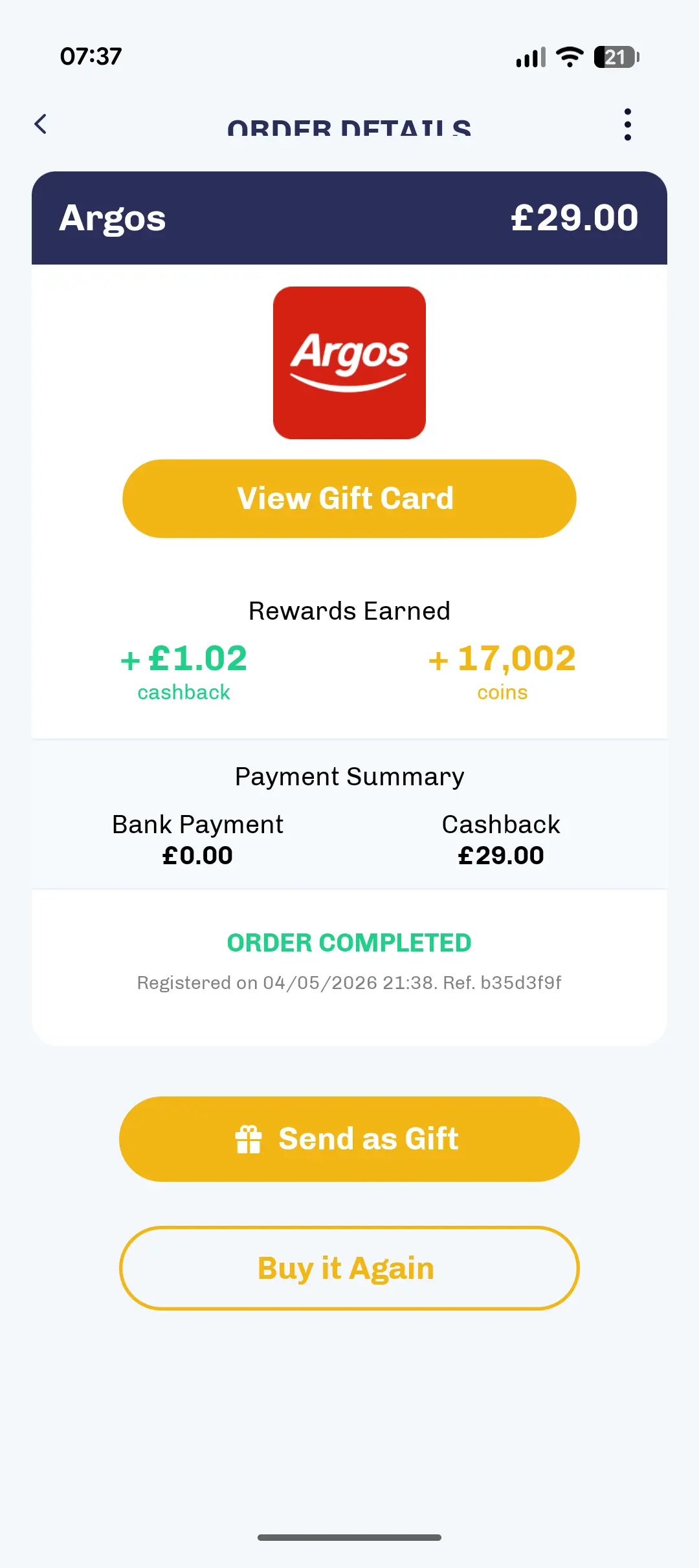
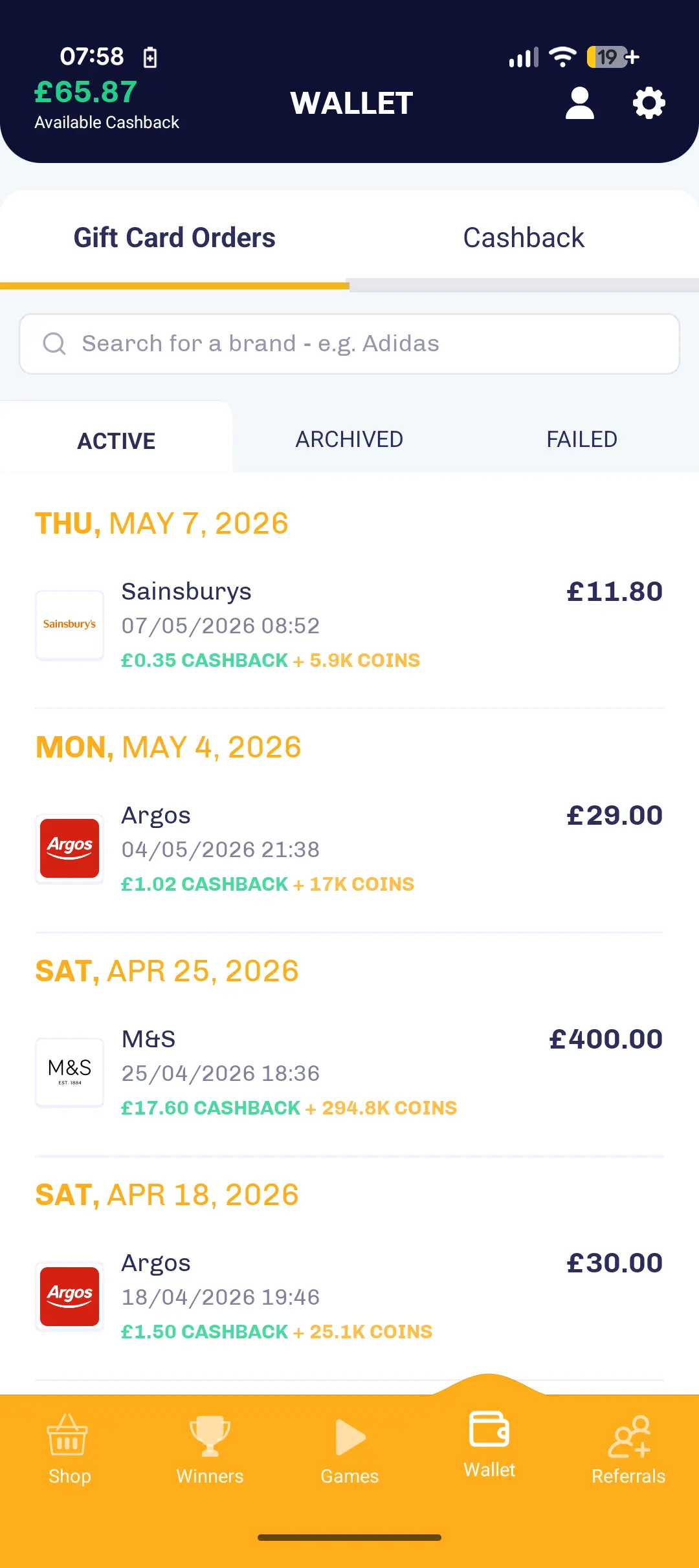
Recent shops from my own account:
- Sainsbury’s £11.80 returned £0.35 cashback + 5.9K coins (May 2026)
- Argos £29 returned £1.02 cashback + 17K coins (May 2026)
- M&S £400 returned £17.60 cashback + 294.8K coins (April 2026)
- Argos £30 returned £1.50 cashback + 25.1K coins (April 2026)
The M&S £400 at 4.4% is the higher end. Premium retailers occasionally offer rates of 8-12% on promotional weeks. Most shopping sits between 2-5% across supermarkets and high-street brands. The breadth is what makes EverUp work as a single-app strategy: Tesco, Sainsbury’s, Morrisons, Asda, M&S, Iceland, Co-op, Aldi all live in the app at varying rates.
That M&S £400 example points to one tactic I use a lot: rather than buying a new gift card every time I shop, I often buy one large gift card and use it over multiple visits. The balance auto-updates in the EverUp wallet as you spend, so you always know what’s left. For monthly food shops at a single retailer this works well. You front-load the cashback in a single purchase, then run the balance down over the next few weeks at the till.
Rates fluctuate weekly. Asda currently pays 3.2%, but I’ve seen it as high as 4% and as low as 2.8% on different weeks. JamDoughnut‘s rates move on a different cycle, which is the whole reason checking both apps before each purchase is worth the 30 seconds.
EverUp only does gift cards. There’s no online affiliate cashback through them, so for retailers that don’t sell as an EverUp gift card you’ll want TopCashback or Quidco. For in-store everyday spend that doesn’t involve a gift card, Airtime or a cashback debit card is the right tool. For utility switches, broadband, insurance and financial products, TopCashback Compare or Quidco Compare are the proper destinations.
That said, gift cards aren’t only for in-store use. If a retailer sells as an EverUp gift card AND is on TopCashback or Quidco, you can stack the two: click through the cashback site, check out on the retailer’s website using your EverUp gift card, and you’ll earn the gift card cashback at purchase plus the cashback site cashback when the transaction tracks.
For a fuller picture of where each platform sits, see the best cashback apps ranking and my supermarket cashback comparison.
For the click-through cashback sites I use for the categories EverUp doesn’t cover, see my TopCashback review (my first choice for online retailer cashback) and Quidco review (for the Quidco exclusives).
How EverUp cashback works
Step 1
Retailer sells wholesale
Retailers sell gift cards to EverUp at a discount
Step 2
You buy through the app
Pay face value for a digital gift card in the EverUp app
Step 3
Instant cashback
EverUp credits some of the difference to your balance straight away
Step 4
Spend at the retailer
Use the gift card at the till for its full face value
EverUp buys gift cards from retailers at a discount and sells them to you at face value, passing some of that discount through as cashback. The retailer gets a paying customer they might not have reached otherwise, EverUp earns a margin on the wholesale-to-retail spread, and you get a discount on money you were going to spend at that retailer anyway. The model is structurally different from affiliate-commission cashback sites like TopCashback and Quidco.
That difference is why the rates are different too. The most EverUp can pay you is whatever discount the retailer gave them when they bought the gift cards in the first place. That’s usually 4-7% on supermarkets, a bit more on premium brands like M&S or John Lewis, less on retailers that don’t give big discounts on gift cards. TopCashback and Quidco can occasionally pay 10% or more during a promotion, because the retailer is paying to attract new customers through that route specifically. EverUp’s rates are steadier and lower at the top end, but they pay instantly and never fail to track.
What it does well
Instant cashback. The cashback is in your balance the moment the gift card is issued. There’s no pending period, no tracking failure mode, no waiting for the retailer to confirm. The transaction happens entirely within the app and is complete the second you tap buy.
Paying at the till is seamless. Scan the gift card barcode from your phone alongside your loyalty card at checkout. EverUp’s cashback stacks with Clubcard or Nectar points, and your normal credit or debit card cashback on the original gift card purchase still applies. Three layers of return on a single shop.
Highest supermarket rates of the gift card apps. Tesco, Asda, Morrisons, M&S, Iceland, Co-op all live in the app at competitive rates. JamDoughnut‘s rates are within a percentage point on most retailers but rarely above EverUp’s. Card-linked apps like Airtime and Onsi don’t compete in this category because their model doesn’t include supermarket gift cards.
Coverage of retailers no other cashback app touches. Aldi is the obvious example. Aldi doesn’t run a cashback partnership of any kind. No affiliate cashback site or app pays you anything for Aldi spend, because Aldi doesn’t pay commission to affiliates. EverUp lists Aldi gift cards anyway and pays coins rather than cashback on them. The coins aren’t a lot, but something at the cheapest supermarket where every other cashback app gives you nothing is better than nothing.
The gift card wallet. Every gift card you buy sits in your wallet with its current balance visible. For most retailers the balance auto-updates after each use, so you know how much is left without having to check the retailer’s site or keep a separate note. Spent cards can be archived, leaving your active gift cards uncluttered while preserving the full history if you ever need it. The wallet is the unsung feature: it removes the “where did I put that gift card / what’s left on it” friction that puts most people off gift card shopping in the first place.
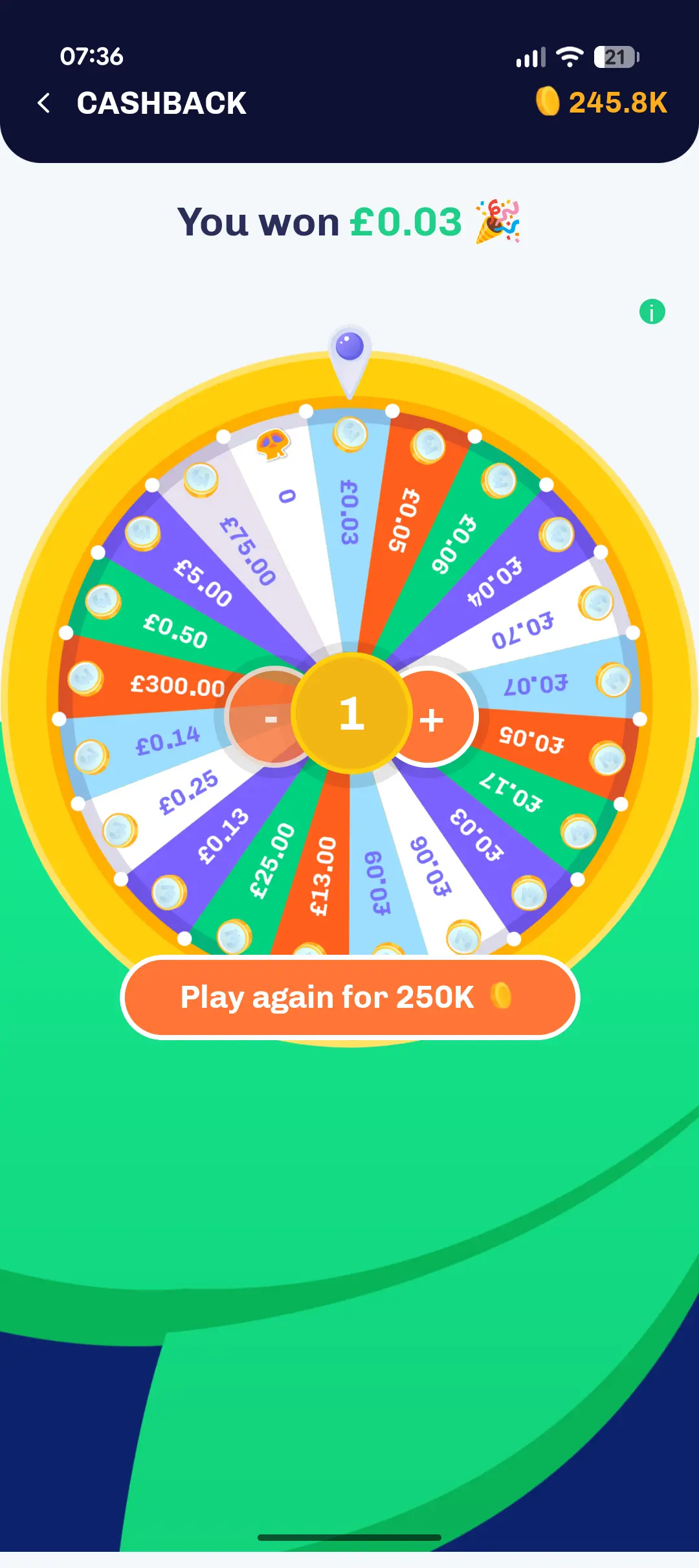
Daily raffle, spin and scratch games. Every gift card purchase earns coins. Those coins can be spent on a daily spin (250K coins per spin) which pays real cashback rather than more coins. Wins range from £0.03 to £300, with most spins paying under £1. There are also daily scratch cards and a weekly raffle. Across a year of regular use the games add up to a few pounds of additional cashback on top of the main rate.
No tracking failures. The cashback is applied at the point of gift card purchase. There’s no affiliate chain to break, no cookies to disable, no merchant to lose the referral. EverUp’s decline rate is effectively zero because there’s nothing to decline. You either bought the gift card or you didn’t.
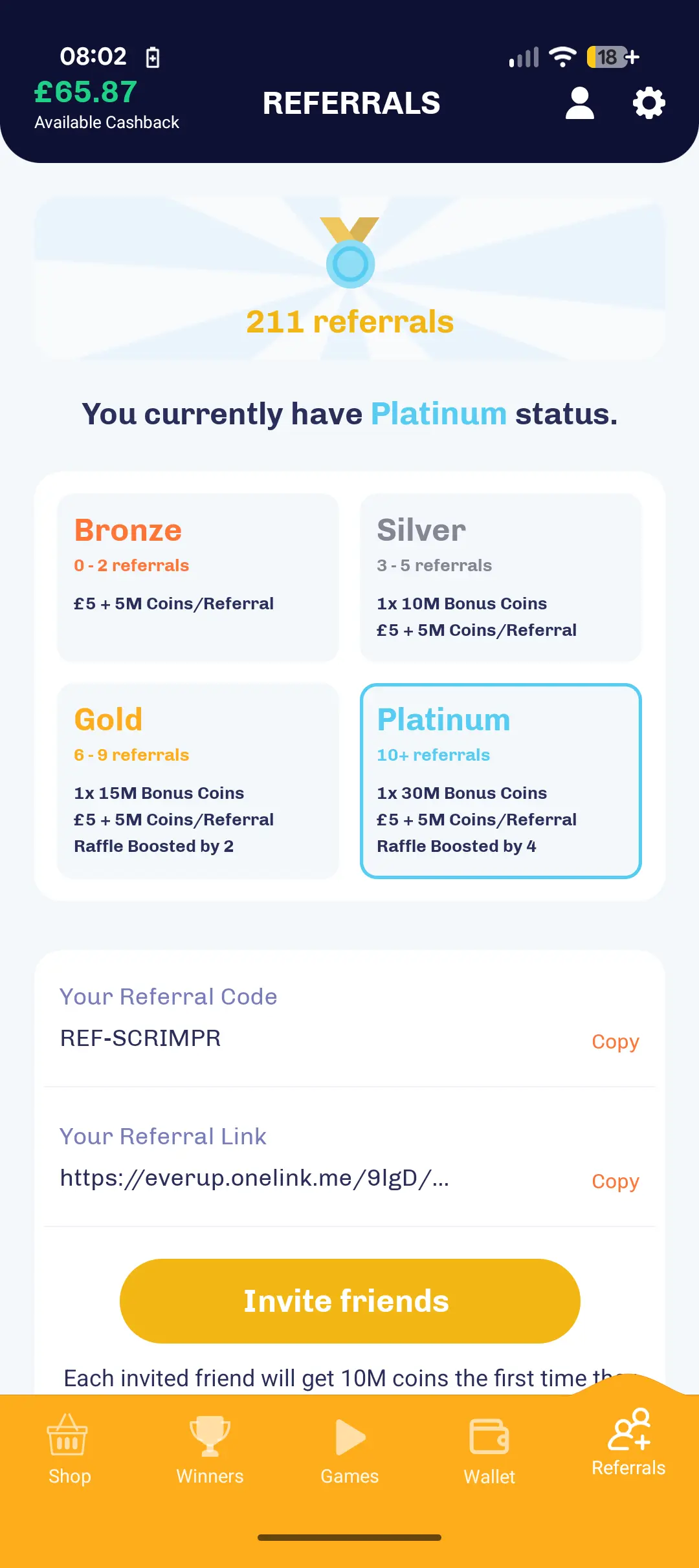
Referral programme with tier bonuses. £5 + 5M coins per qualifying referral, with one-off coin bonuses and permanent raffle multipliers at higher tiers. The tiers are Bronze (0-2 referrals), Silver (3-5), Gold (6-9), and Platinum (10+). At each tier upgrade you get a one-off coin bonus (10M at Silver, 15M at Gold, 30M at Platinum), and Gold and Platinum members get permanent raffle entry multipliers (x2 and x4 respectively). Handy if you’d refer friends or family.
For the other cashback apps I check alongside EverUp, see my JamDoughnut review (the other gift card cashback app) and Airtime review (card-linked in-store cashback for a different retailer mix).
Where it falls short
The rates have a hard ceiling. EverUp’s rates rarely exceed 5-7% on the highest-paying retailers and sit at 2-4% on supermarkets. For one-off promotions or financial product sign-ups, affiliate cashback sites can occasionally offer 10-25%. EverUp’s gift card model can’t compete with that, because the ceiling on what a gift card discount can ever be is whatever discount the retailer gave EverUp in the first place.
Gift cards give you weaker consumer protection than paying directly. Two things to know. First: if you’d normally pay by credit card and rely on Section 75 protection for purchases over £100, paying via an EverUp gift card breaks that chain. Your Section 75 protection covers your credit card payment to EverUp, not your subsequent spend at the retailer. Second: if you return something bought with a gift card, you get gift card credit back, not cash. You’re locked into shopping with that retailer again to use it. Both of these are reasons I use EverUp for places I shop frequently (supermarkets especially, where returned items still convert into next week’s shop) and not for one-off big-ticket purchases where I might actually need the consumer protection.
The £10 withdrawal threshold to bank. Anything in your balance is spendable on another gift card from £1, but to withdraw cash to your bank you need to have crossed £10. If you’ve earned £8.40 and want cash rather than another gift card, you’ll need to keep earning until you cross £10.
Smaller scale than the big affiliate cashback sites. EverUp has a few hundred Trustpilot reviews; the bigger affiliate sites have tens of thousands. Both are legitimate operations, but EverUp is a younger and smaller business. The pivot from prize-linked savings to gift card cashback in 2023 means the current product is recent.
Is EverUp safe?
Yes. EverUp Limited is a registered UK company. The app is on both the iOS App Store and Google Play, and the Trustpilot reviews are mostly positive (4-star average on a smaller sample size than the older cashback sites). The main safety question with any cashback app is whether you’ll actually get paid. EverUp adds the cashback to your wallet the moment you buy the gift card, before you’ve even spent it, so there’s nothing to track and nothing to fail later.
EverUp is smaller and younger than TopCashback or Quidco, especially since the 2023 pivot from savings app to gift card cashback. That’s not a red flag in itself, but it’s why I keep my balance low and withdraw or spend regularly rather than letting it build up.
What I’ve earned
A household spending £150 a week on supermarket shopping through EverUp at the current 2-4% supermarket rates earns somewhere between £150 and £300 a year. A household spending £200 a week earns between £200 and £400. That’s the steady, predictable money the app makes available. It’s reliable, and instant. Spendable the same day it lands.
The category breakdown is straightforward: supermarkets are the biggest predictable category for most households, where EverUp’s rates are competitive and the spend is reliable week to week. Outside that, the occasional Boots, Costa, M&S Clothing or Argos gift card on shopping you’d do anyway adds £20-40 a year. Premium retailers occasionally offer higher rates of 8-12% but these are smaller-volume purchases for most shoppers.
What’s not realistic from EverUp: any single-transaction win above £20-30. The model doesn’t really do “big” payouts. The biggest cashback wins on affiliate sites tend to be utility switches, broadband, or financial product sign-ups. EverUp doesn’t sell any of those, so the windfalls live elsewhere. EverUp is the steady drip, not the windfall.
It’s not life-changing money. But it’s money that’s best back in your pocket!
How EverUp compares on live rates right now
Here’s a live snapshot of current cashback rates on supermarket gift cards across both gift card cashback apps. EverUp leads on most supermarkets most of the time, but rates fluctuate weekly and JamDoughnut wins on promotional weeks. The annual figure shows what you’d earn at £3,000 of typical yearly gift card spend with whichever app is paying more.
Instant cashback rates last updated: 25 September 2026
| Gift Card | Instant Cashback | Via | |
|---|---|---|---|
 Tesco
Best Rate
Tesco
Best Rate
|
5.0% instant | TCB Giftcards.com | |
 Sainsbury's
|
5.0% instant | TCB Giftcards.com | |
 Morrisons
|
5.0% instant | TCB Giftcards.com | |
 Asda
Asda
|
3.0% instant | JamDoughnut | |
 Aldi
Aldi
|
3.0% instant | Onsi |
Your Potential Savings
Based on £3,000/year grocery shopping:
Best rate (Tesco via TCB Giftcards.com - 5.0%)
saves you £150/year
For any specific gift card purchase, check Scrimpr’s supermarket cashback comparison before tapping buy. Rates shift weekly and the leader changes.
How to sign up for EverUp
- Use my EverUp referral link*. Referral code REF-SCRIMPR populates automatically.
- Download the app on iOS or Android, verify your email and phone number.
- Buy your first gift card through the app. Cashback is added to your balance instantly.
- Once you’ve earned £10 in cashback, your 10 million bonus coins land in your account.
- Play the in-app games to swap coins for additional cashback.
One catch with the bonus: the 10M coins require you to actually earn £10 of cashback first, not just sign up. At 2-4% supermarket rates that’s around £250-500 of gift card spend to unlock the bonus, so realistically a few weeks of normal supermarket shopping rather than immediate.
Payouts
Withdraw to bank transfer from £10 minimum, no fee, arrives in 1-3 working days. Or spend your balance immediately on another gift card from £1. The same financial outcome whether you withdraw the cash and use it to buy something at the retailer directly or use the balance to buy another gift card through the app.
EverUp Quick Facts
| Rating | ★★★★ 4.5/5.0 |
| Year Launched | 2021 |
| Region | UK |
| Min Age | 18+ |
| Signup Bonus | 10M coins after £10 earned |
| Min Cashout | £1 |
| Payout Speed | Instant in-app |
| KYC Required | No |
| Referral Program | Yes |
| Mobile App | Yes |
| Retailer Count | 300+ |
| Browser Extension | No |
| Card Linking | No |
| In-Store Cashback | Yes |
| Covers Utilities | No |
Should you use EverUp?
If your weekly food shop is £50 or more and you’re not already using a gift card cashback app, yes. Sign up. The 2-4% supermarket rate applied to the largest predictable spend most households have adds up to £200-400 a year without changing what you buy.
If you’re already on JamDoughnut, check both apps before each gift card purchase rather than defaulting to either. The rates shift, JamDoughnut runs matched-rate promotions periodically, and EverUp’s lead is narrow enough that the right answer changes from week to week. The 30 seconds to compare is worth £10-20 a year.
If you’re new to cashback entirely, start with my complete cashback guide. The principles matter more than the platform you pick first. For most readers I’d recommend TopCashback first (broadest retailer coverage), then EverUp for supermarkets specifically, then JamDoughnut as a comparison check, then Airtime for in-store everyday spend.
For maximum cashback overall, layer it. My cashback stacking guide covers combining cashback apps with credit card cashback, debit card cashback, and gift card discounts on the same purchase. The most effective strategy isn’t choosing one platform. It’s stacking them properly, and EverUp’s till mechanic stacks cleanly with loyalty cards and card-based cashback on top.
Always check the cashback comparison tool first. It’s the easiest way to see which app is winning on the gift card you want this week.
Frequently Asked Questions
How does paying with an EverUp gift card actually work at the till?
You buy the digital gift card on your phone in the EverUp app at the checkout, then scan the gift card barcode straight from the app at the till. It works the same way as a loyalty card. The cashier scans it, the gift card balance gets used to pay your shop, and you can still scan your Clubcard, Nectar or equivalent on the same transaction. Loyalty points build normally, and any cashback you’d get from your credit or debit card on the original gift card purchase also still applies. The whole thing takes 30 seconds longer than a normal payment.
What’s the difference between EverUp and JamDoughnut?
Both apps work the same way structurally. You buy digital gift cards through the app and earn instant cashback as a discount on the card. The differences are at the rate level and the breadth level. EverUp tends to pay slightly higher rates on supermarkets (Tesco, Asda, Morrisons in particular) and covers more retailers (300+ vs JamDoughnut’s smaller catalogue). JamDoughnut occasionally runs matched-rate promotions that close the gap. The honest answer is to check both before any sizeable gift card purchase rather than commit to either.
Is EverUp the same as TopCashback?
No, the models are fundamentally different. TopCashback is an affiliate cashback site where you click through their links to a retailer’s website, the retailer pays TopCashback a commission, and TopCashback passes some of that back to you. EverUp is a gift card cashback app where you buy a digital gift card through the EverUp app at face value, and EverUp credits you with cashback as a discount on that gift card purchase. TopCashback’s cashback typically takes 30-90 days to confirm and pays on a much broader range of online purchases. EverUp’s cashback is instant but limited to retailers where you can pay with a gift card.
Why does Aldi only earn coins on EverUp and not cashback?
Aldi doesn’t run a cashback partnership of any kind. TopCashback, Quidco, JamDoughnut, Airtime and the rest all show no cashback for Aldi because Aldi doesn’t pay commission to affiliates. EverUp lists Aldi gift cards anyway and gives you coins on every purchase. The coins are small compared to a proper cashback rate, but it’s the only way to earn anything at Aldi through a cashback app. Something is better than nothing.
Are the bonus coins and games worth anything in real money?
Yes. The spin pays out actual cashback rather than more coins. Wins range from £0.03 to £300, with most spins paying under £1. There’s a daily scratch card, a daily spin, and a weekly raffle. Across a year of regular use the games add up to a few pounds of additional cashback on top of the main rate. Treat them as a small bonus on top of the cashback you’d be earning anyway, not as a reason to buy gift cards you don’t need.
How does the EverUp referral programme work?
EverUp pays £5 + 5M coins per qualifying referral, with tier bonuses at higher referral counts. The tiers are Bronze (0-2 referrals), Silver (3-5), Gold (6-9), and Platinum (10+). At each tier upgrade you get a one-off coin bonus (10M at Silver, 15M at Gold, 30M at Platinum). Gold and Platinum members also get permanent raffle entry multipliers (x2 and x4 respectively), which boost your chances on the weekly raffle.
Why has my EverUp cashback not appeared?
EverUp’s cashback is applied at the moment of gift card purchase, so unlike affiliate cashback sites it doesn’t really have a ‘not tracked’ failure mode. If your purchase went through and you received the gift card, the cashback should be in your balance. If something’s gone wrong, it’s almost always a payment processing issue (declined card, banking issue) rather than a tracking issue. Check the transaction status in the app first, then contact EverUp support if the gift card was issued but the cashback didn’t credit.
Can I use EverUp and TopCashback on the same purchase?
Yes, and you should. They don’t compete on the same transactions. EverUp pays you when you buy a gift card. You then take that gift card to the retailer. TopCashback (and credit card cashback) pay you for online retailer purchases through affiliate links. You can also pay your supermarket bill with a cashback debit card and earn additional cashback that way. See my cashback stacking guide for combining these properly.
What is a cashback site and how does it work?
A cashback site is a middleman between you and the retailer. When you click through to a shop using a cashback site link, the retailer pays the cashback site a commission for sending you their way. The cashback site then passes most of that commission back to you as cashback in your account. You don’t pay anything extra, you don’t share your card details with the cashback site, and you generally pay the same price you would have paid by going to the retailer directly.
The whole system is funded by retailers, who treat the commission as a marketing cost. Cashback sites compete on how much of that commission they pass back to members, the breadth of retailers they cover, and how easy they make the payout process.
Are cashback sites safe and legitimate?
The established UK cashback sites (TopCashback, Quidco, Rakuten, KidStart and a handful of smaller ones) are legitimate and have been operating for over a decade in most cases. They are registered companies, regulated by the same consumer protection laws as any UK e-commerce business, and have paid out hundreds of millions of pounds between them. You don’t share payment card details with the cashback site itself, you don’t pay a membership fee, and there is no upfront cost.
Smaller or newer cashback sites can be riskier. If a site looks new, doesn’t list a registered company name, or asks for unusual personal information up front, treat it with caution. The reviews on Scrimpr only cover cashback sites that have a track record of paying out reliably.
How long does it take to get my cashback?
There are usually two stages. Pending cashback appears in your account within a few days of your purchase, sometimes within minutes. It is the cashback site’s record that your click-through resulted in a sale. Confirmed cashback lands once the retailer has reviewed the transaction and accepted that it was valid (you didn’t return the item, the order wasn’t cancelled, the payment didn’t bounce). Confirmation typically takes between 30 and 90 days, and some retailers can take six months or more.
Once your cashback is confirmed, withdrawing it to your bank account or PayPal usually arrives within a working day. The slow part of the process is almost always the retailer side, not the cashback site side.
Why has my cashback not tracked?
Tracking failures are the single most common complaint with any cashback site, and the cause is almost always one of the following:
- Cookies were blocked or cleared between clicking through and checking out. The cashback site uses a cookie to remember which member sent you to the retailer, and if the cookie is missing the sale won’t be attributed to you.
- An ad-blocker, privacy extension or VPN silently dropped the tracking request. This is the cause in a large share of cases where the member is certain they did everything right.
- You browsed the retailer’s site separately before clicking through. Most retailers attribute the sale to the most recent affiliate cookie, so an earlier direct visit can overwrite the cashback site’s tracking.
- You used a discount code that wasn’t sourced from the cashback site. Many merchants void the cashback entirely if you apply an external code at checkout. Always check whether the cashback site lists the code before using it.
- The retailer treats your purchase category as ineligible. Some retailers exclude certain product categories from cashback (gift cards, subscriptions, in-store collections etc.). The merchant page on the cashback site usually lists the exclusions.
If your cashback hasn’t tracked after the expected window, raise a “missing cashback” ticket through the cashback site with your order number, the date and time of purchase, and the merchant’s confirmation email attached.
What does "confirmed" cashback mean?
Confirmed cashback is cashback that the retailer has reviewed and accepted as a valid sale. Only confirmed cashback can be withdrawn. Until your cashback is confirmed, it sits in a pending state and could in theory still be voided (typically if you return the item, cancel the order, or the payment fails after the fact). In practice, most pending cashback does eventually confirm, but it can take longer than you might expect.
Can I use cashback sites alongside discount codes?
It depends on the retailer and where the code came from. Voucher codes that are listed directly on the cashback site itself are normally safe to use, because the cashback site already knows about them and won’t void your transaction. Codes sourced from other voucher sites or social media often invalidate your cashback entirely.
The safest approach is to check the cashback site’s merchant page before completing your purchase. If a code is listed there, it should stack. If it isn’t, you may need to choose between using the code or earning the cashback, and for higher-value purchases the cashback is often the better deal.
Can I use multiple cashback sites at the same time?
Yes. The vast majority of people who take cashback seriously have accounts on TopCashback, Quidco and Rakuten as a minimum, and check the rates at each before clicking through. Rates and exclusive deals vary between sites, so the same purchase can pay quite different amounts depending on where you start.
You can only use one cashback site per transaction, however. The site you clicked through from last is the one that gets attributed to the sale, so don’t bounce between cashback sites during checkout.
Is cashback taxable in the UK?
Cashback earned on personal shopping is not taxable in the UK. HMRC treats consumer cashback as a discount or rebate rather than income, so it falls outside the tax system and doesn’t need to be declared. This applies whether the cashback is paid through a dedicated cashback site, a credit card scheme, or as part of a current account reward programme.
The picture changes if you are using cashback as part of a business or trading activity (for example, if you operate a buy-and-resell business and the cashback effectively reduces your cost of goods). In that case the cashback would normally be netted off against the cost of the purchase rather than counted as income, but the right answer depends on your specific setup. If in doubt, check with HMRC or an accountant.
What’s the difference between a cashback site and credit card cashback?
A cashback site pays you a percentage of the retailer’s commission whenever you click through their link. A cashback credit card pays you a percentage of every purchase you make on the card, regardless of where you shop or how you got there.
The two stack cleanly. You can click through a cashback site to a retailer, pay with a cashback credit card, and earn cashback from both sources on the same transaction. For larger purchases, stacking cashback site rewards with a 1-2% cashback credit card can meaningfully reduce the net cost.
Why does the cashback I earn sometimes get voided?
The most common reasons for a confirmed cashback being voided after the fact are: the order was cancelled or refunded, you returned the item, the payment was charged back, you used a discount code that wasn’t listed on the cashback site, you registered a duplicate account at the retailer, or the retailer disputed the transaction with the cashback site.
If the cashback was voided in error, you can raise a dispute with the cashback site and supply your order confirmation, payment receipt, and any other proof that the transaction was valid. Most cashback sites will manually reinstate the cashback if you provide good evidence.
Is using a cashback site free?
Yes. Established UK cashback sites are free to join and free to use. You don’t pay a membership fee, you don’t share payment card details with the cashback site itself, and withdrawals to your bank or PayPal don’t cost anything. The site makes its money from the share of retailer commission it keeps when it passes the rest back to you.
Some sites offer an optional paid tier (Quidco Premium is £5/year, for example) that bumps your rates on selected retailers and gives you priority customer support. The free tier still works fully without ever upgrading.
Are cashback sites only for online shopping?
Mostly, yes, but not entirely. The bulk of cashback comes from clicking through a cashback site to an online retailer before checkout. However, several cashback sites also offer:
- In-store cashback through prepaid gift cards — you buy a gift card on the cashback site at a discount or with cashback attached, then use it at the till.
- Card-linked cashback — link a debit or credit card to the app, spend at participating retailers in-store, cashback is tracked automatically.
- Utility, insurance and broadband switches — handled through embedded comparison tools on the cashback site itself, with cashback paid for completed switches.
For everyday in-store spend, dedicated cashback debit cards and Airtime usually pay more than the in-store features of general cashback sites.
Is cashback worth doing for small purchases?
Honestly, no — most cashback under about £1 is a poor use of your time, especially if it requires clicking through a comparison tool and remembering to start your shopping journey from the cashback site. The bigger the purchase, the more cashback matters. A 5% rate on a £400 mobile contract switch pays £20 for thirty seconds of effort. A 5% rate on a £4 add-on order pays 20p.
The realistic value of any cashback site is in the larger discretionary purchases (insurance, broadband, mobile contracts, holidays, white goods) where 30 seconds of comparing rates can return £50-£100+ of cashback. The small everyday tracked purchases are a bonus on top, not the main event.
How do cashback sites make money, and what does "100% cashback" actually mean?
The major UK cashback sites (TopCashback and Quidco) operate on a “100% cashback” model. That phrase is widely repeated and often misunderstood. It does not mean you get 100% of what you spend back. It means the cashback site passes on 100% of the affiliate commission the retailer pays them, without skimming a margin from your share. So if a retailer pays a 5% commission, you receive the full 5% as cashback rather than 4% with the cashback site keeping 1%.
These sites earn their actual revenue from two separate sources:
- Retailer bonuses (overrides) — extra payments that retailers make to top-performing affiliates for hitting agreed volume targets. These are paid by the retailer on top of the per-transaction commission and aren’t allocated to any individual customer.
- Optional paid tiers — TopCashback Plus and Quidco Premium (£5/year) are opt-in upgrades for boosted benefits.
Despite claims published elsewhere, neither TopCashback nor Quidco silently retains £5-£12 a year, or any percentage of your cashback, on the standard Classic tier. Both companies’ published terms confirm that Classic membership has no automatic deductions, and Quidco’s own help docs explicitly state the same.
See our reviews of other cashback sites and apps